 Asal Ku Training
Start here › Lesson 10
Connecting trees into a forest
Join your tree to a relative's tree through a person you have in common, and choose exactly what each family can see of the other.
In this lesson you will learn
- What a forest is, and when to use one
- How to connect the same person across two trees
- How the other family accepts, and what each side chooses to show
- How to read the Forests page and a whole forest on one screen
- How to control who can find your trees, and how to disconnect
What is a forest, and why?
Your cousin keeps her own tree. So does your uncle. When the same person is in two trees, you can connect them. The connected trees become a forest, and you can see everyone together on one screen.
A connection only joins what you see. Each family keeps its own tree and its own people. Nobody can edit the other family's tree through a connection. If the two trees disagree about a person's parents, each side chooses which parents to show.
Connect a person to another tree
You need to be an owner or manager of your tree. Pick a person who is in both trees.
Open your tree and select the person: on a phone press and hold them, on a computer click them.
Choose Connections. If they are not connected yet, a message says so.
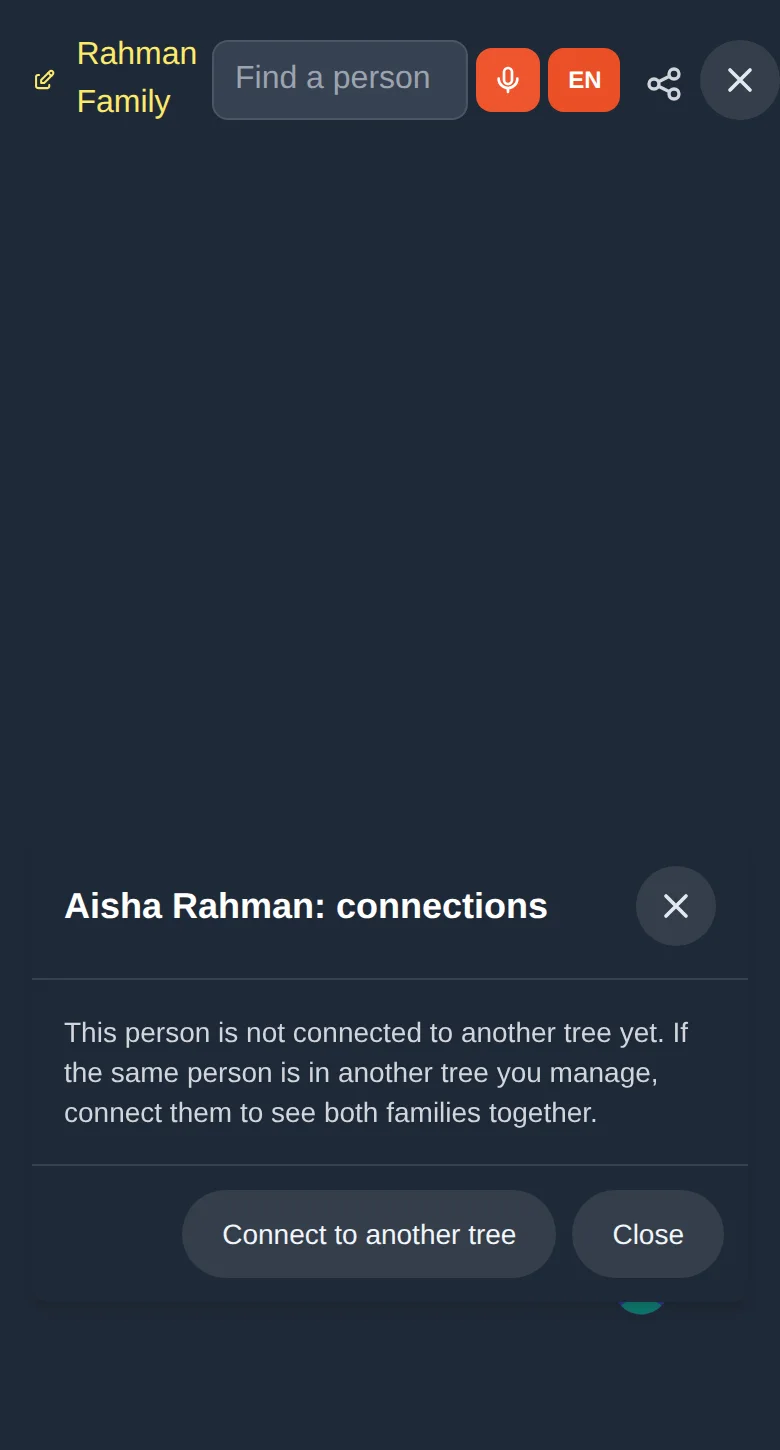
A person who is not yet connected to another tree Tap Connect to another tree.
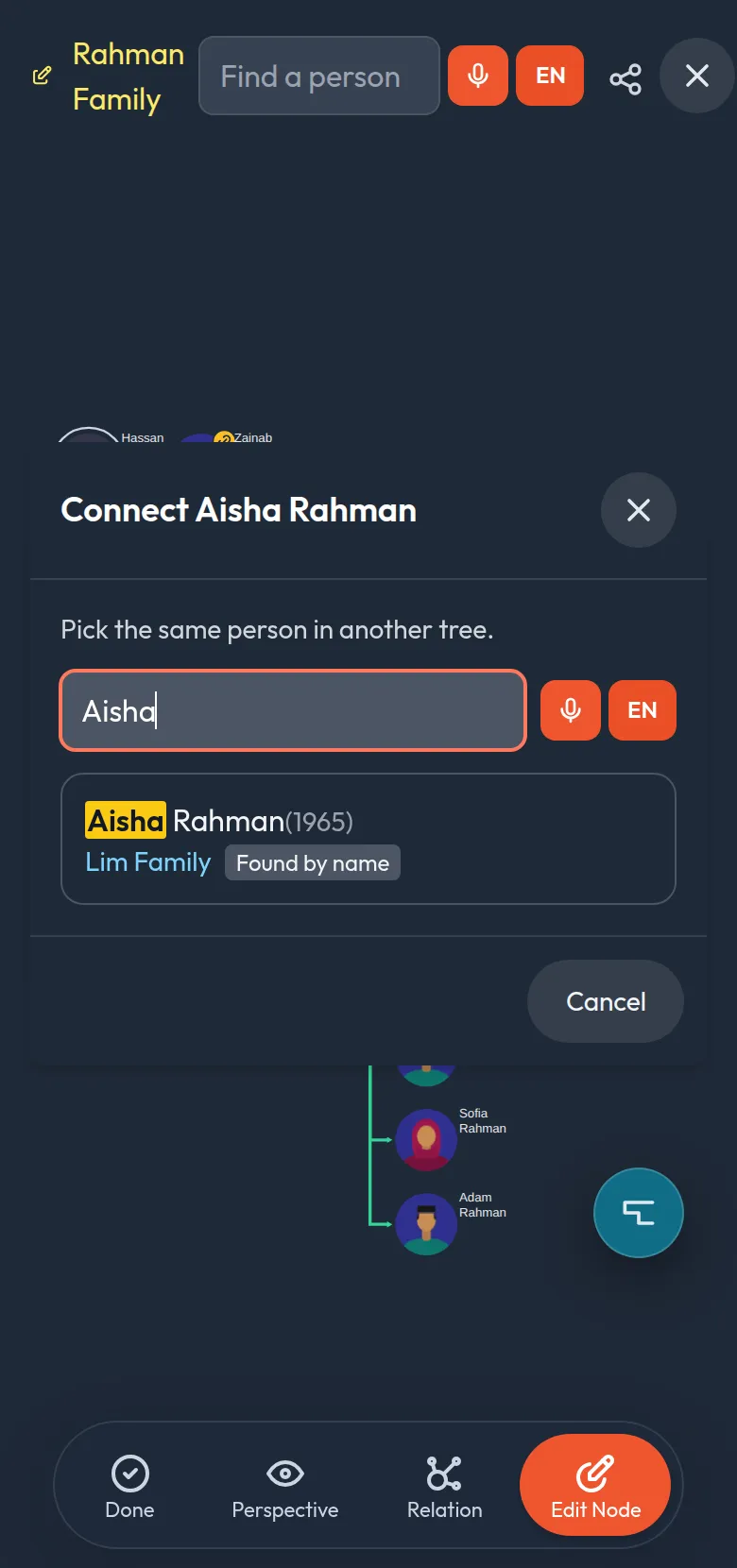
The list you first see holds only people in trees you can open: yours, ones you manage and ones shared with you. To connect to someone else's family, type the person's name (3 letters or more) in the search box: trees whose owners allow being found appear then. Names are matched loosely, so a slightly different spelling is found.
Tap the right person. A label tells you whether the other tree is one you can open, or Needs approval (it belongs to someone else).
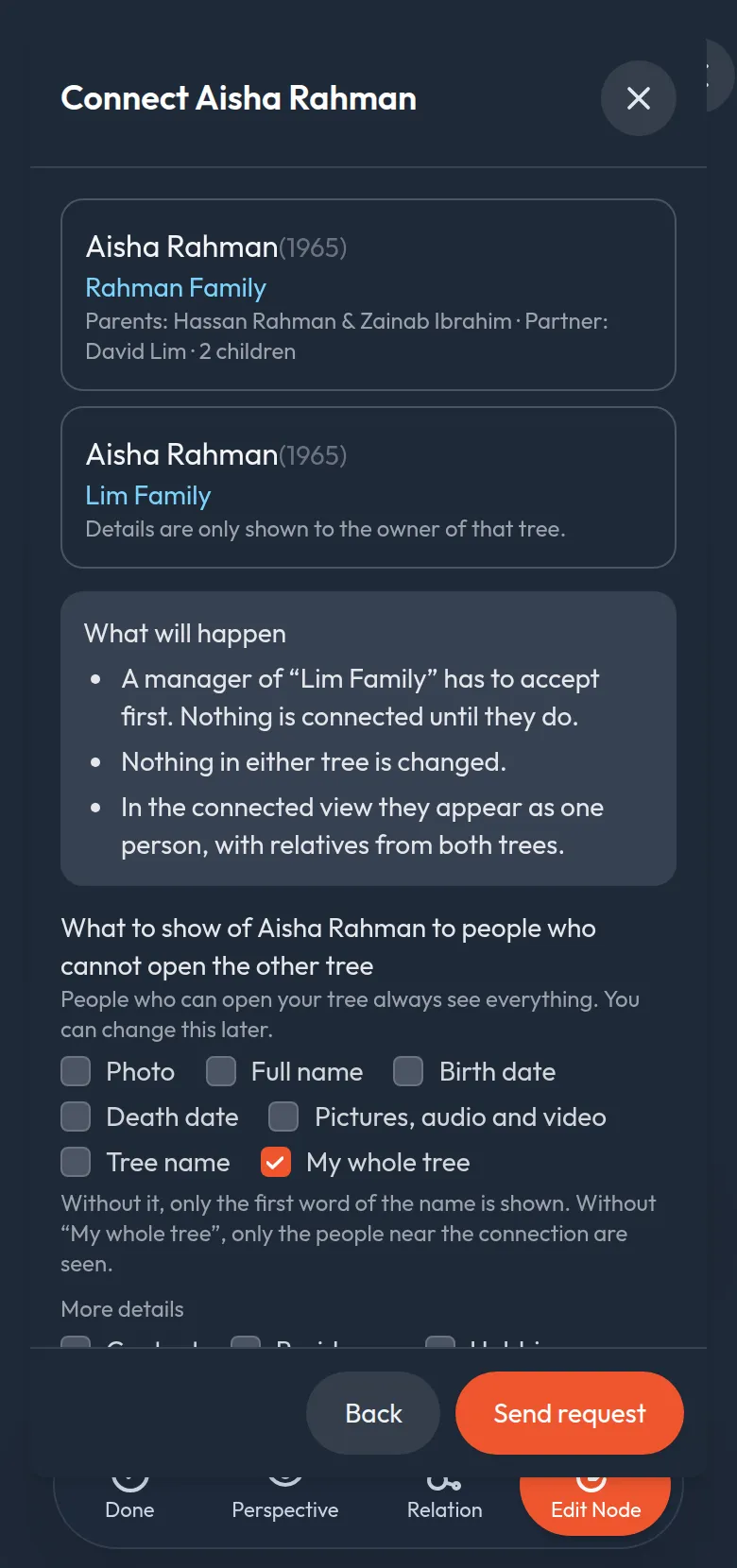
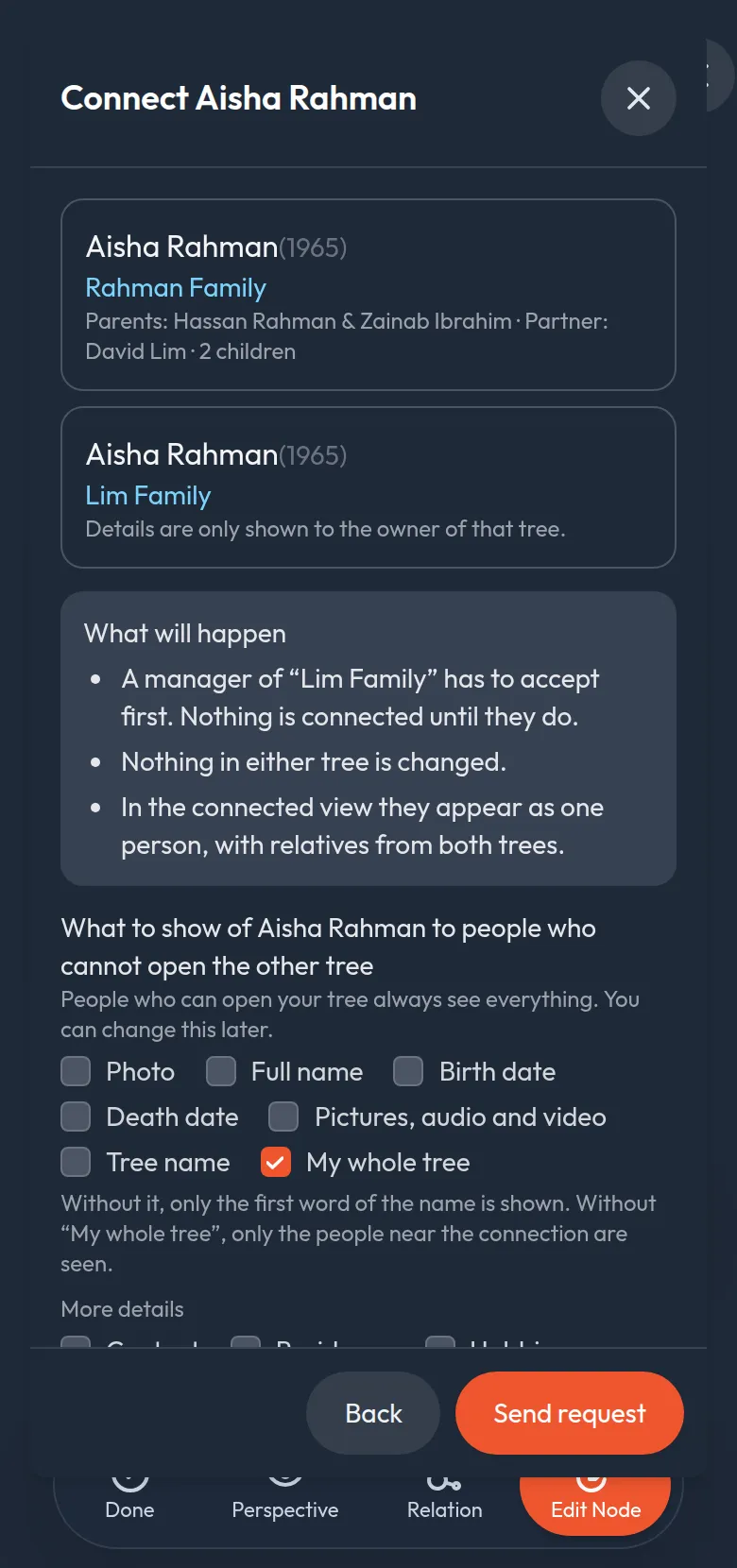
Check the confirmation screen. It shows both people side by side with their parents, and "What will happen": nothing in either tree changes, and the person appears as one in the connected view.
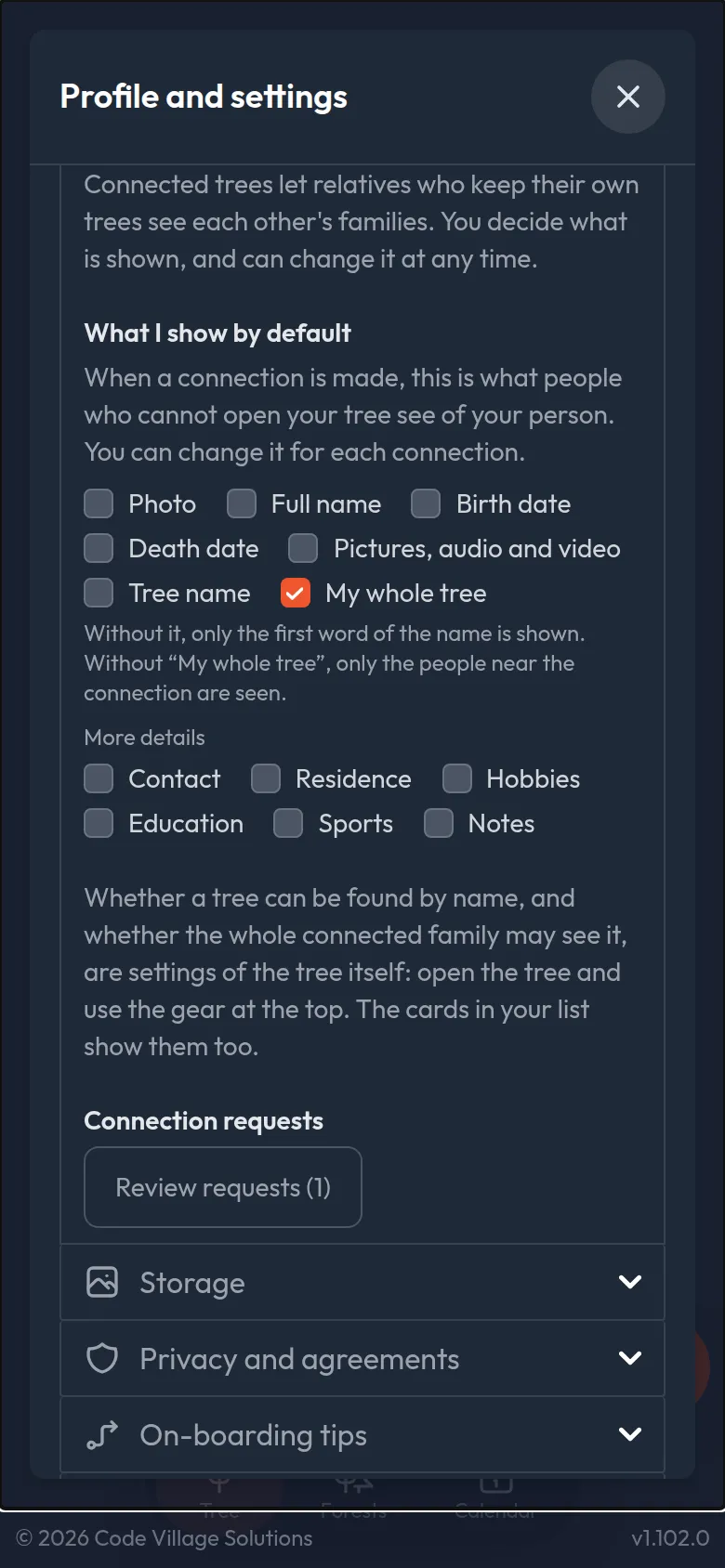
Under "What to show of … to people who cannot open the other tree" tick what you are happy to share (see the next section).
If the other tree belongs to someone else, a note reminds you that what is seen through the connection also depends on that owner (what they share, and the forest agreement). You cannot change that for them.
Tap Connect them.
Choosing what the other family can see
People who can already open your tree always see everything in it. This choice is only about people in the other family's tree. Each person's connection has its own list of tick boxes. At first only the first word of the name is shown.
| Tick box | What the other family sees |
|---|---|
| Photo | The person's portrait |
| Full name | The whole name. Left unticked, only the first word of the name is shown. |
| Birth date, Death date | The dates |
| Pictures, audio and video | The person's gallery, read-only |
| Tree name | The name of your tree. Hidden unless you tick it. |
| My whole tree | Every person of your tree can be seen by the connected family, each with only the details you ticked. Without it, only the people near the connection are seen. Connections made before this option was added keep that behaviour until you change them. |
| Contact, Residence, Hobbies, Education, Sports | Those groups of extra details |
Open the person's Connections, and each connection has its own tick boxes. You can also set your default choices for new connections in Profile and settings → Connected trees (lesson 12).
Nothing is lost when two people are joined. A person who is in two connected trees is shown once, with the details, pictures and recordings of both put together (a tree you cannot open adds only what that family chose to share). If the two trees spell the name or record a date differently, the panel shows the other version too (Also named, Also recorded as born).
Which portrait do I see? If the same person has a photo in more than one connected tree, you choose which one you see in your own connected view: open the person and tap Choose portrait (the same choice is in the person's edit form). Automatic goes back to the nearest tree's photo. Built-in avatars are not offered, only real photos, and only those that family shares.
The forest agreement: who sees beyond one step
By default a connected family sees only the trees linked straight to it. If you want the whole forest to be able to see your tree, give the forest agreement. It is a setting of the tree itself: open the tree, tap the gear at the top, and switch on Let the whole connected family see this tree. You are also offered it when you connect a person or accept a request.
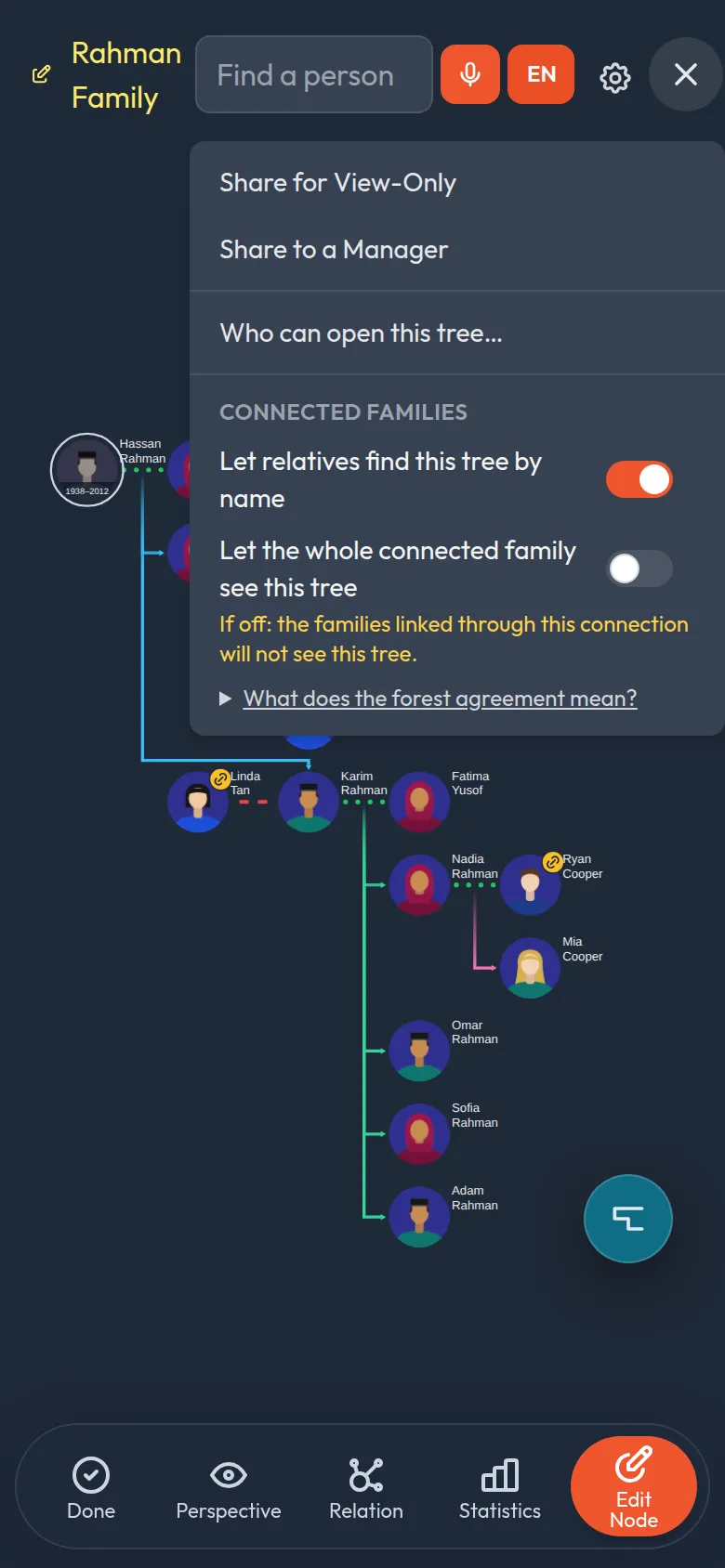
- People looking at a connected family from another tree can see your tree even if theirs is not linked to it directly, as long as every tree in between has agreed too.
- They see only what you share on your connections (and My whole tree if ticked). Never more.
- It is view only: nobody can change your tree, and nobody becomes a viewer or manager of it.
- It covers all the connections of that tree. You can withdraw it at any time, and it stops at once.
You will not have to remember it. The two switches of a tree, Being found and the Forest agreement, appear exactly where they matter, with a line saying what happens if one is off:
- When you send a connection request, the forest agreement of your tree is in the last step, before you confirm.
- When you accept a request, both switches are at the top of the card, in amber while one of them is off.
- Afterwards, if one of your trees is connected to another family but has not given the forest agreement, an amber reminder at the top of the trees and Forests pages says so, with Turn on and Not now. Nothing is ever turned on unless you tap it; Not now hides the reminder for that tree.
The switches are the same everywhere, so a change in one place shows in the others, on every device that can open the tree. Only the tree's owner can change them: a manager sees them greyed out, with On or Off beside each, so they know the current state. Your tree cards show them too: a lit magnifier means relatives can find the tree by name, a lit people mark means the whole connected family can see it, and a dim crossed-out mark means it is off.
The other family accepts
A connection to a tree owned by someone else is a request. Nothing is joined until the other family says yes.
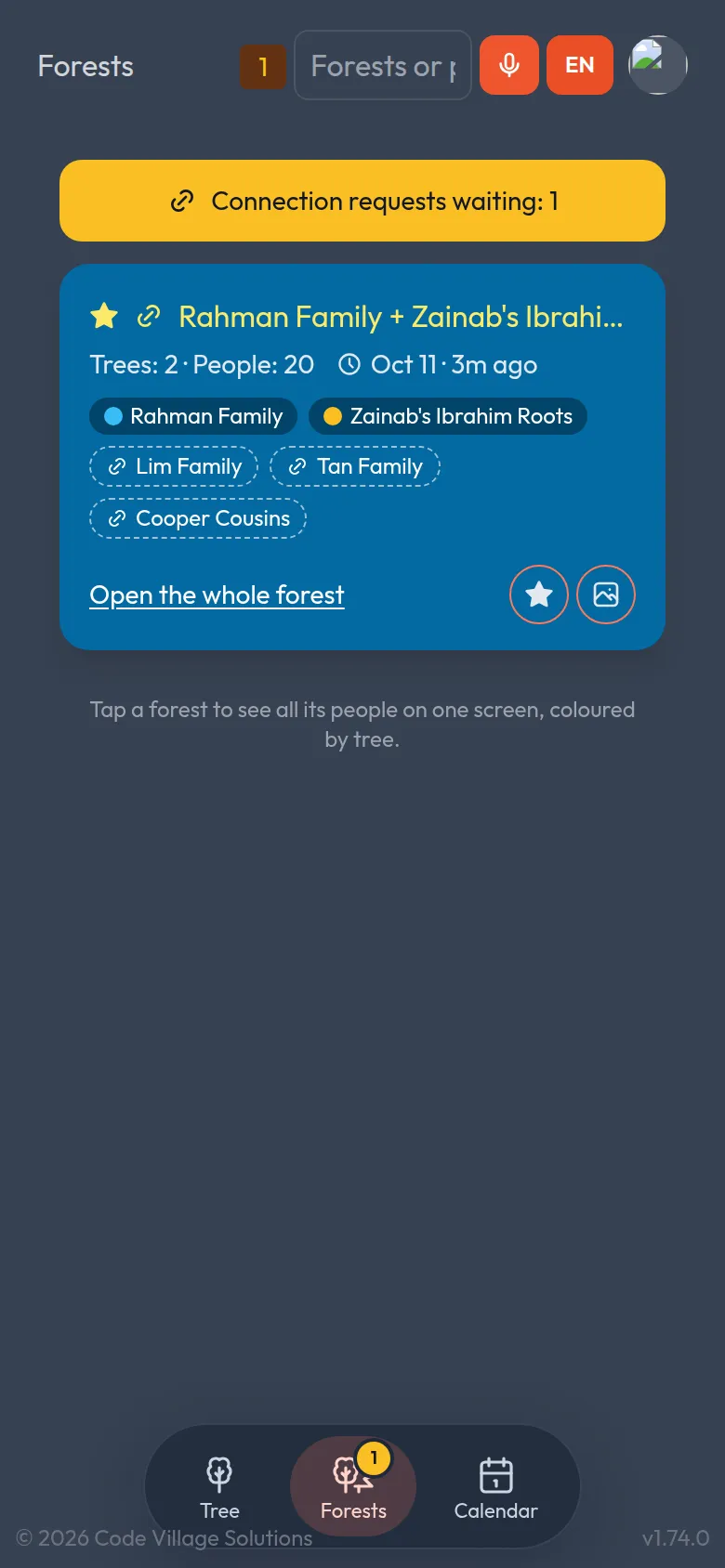
The owner (or a manager) of that tree sees a yellow bar on the Forests page: "Connection requests waiting", and a yellow number on the Forests button.
They tap the bar and see who is asking, for which person, and what the other side shows.
They choose what their side shows and tap Accept, or Decline.
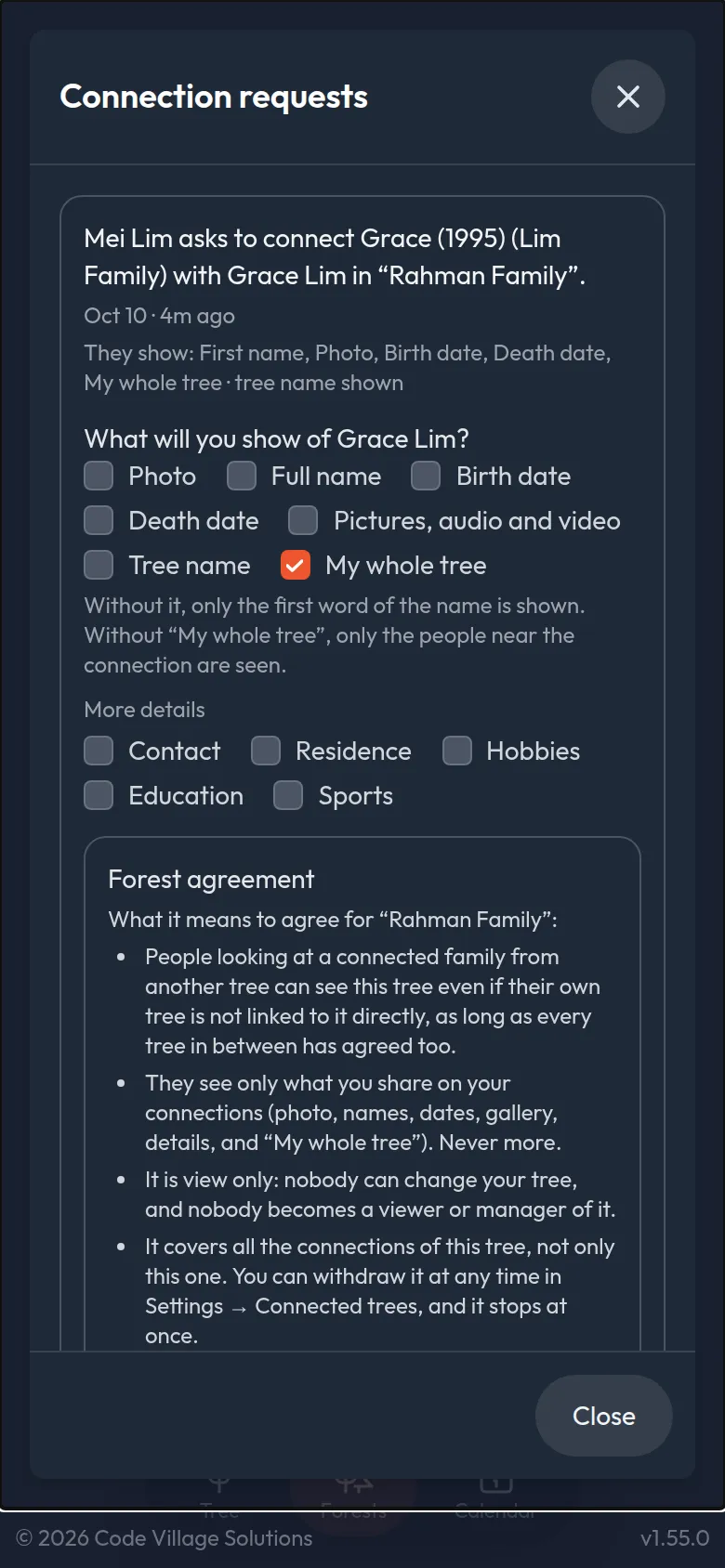
You are told straight away when your request is accepted or declined. A request you made waits under Requests I sent, with how long ago you sent it. A grey bar on the Forests page (Requests I sent, waiting for an answer) opens that list, and so does Open requests in Profile & settings → Connected trees.
The Forests page
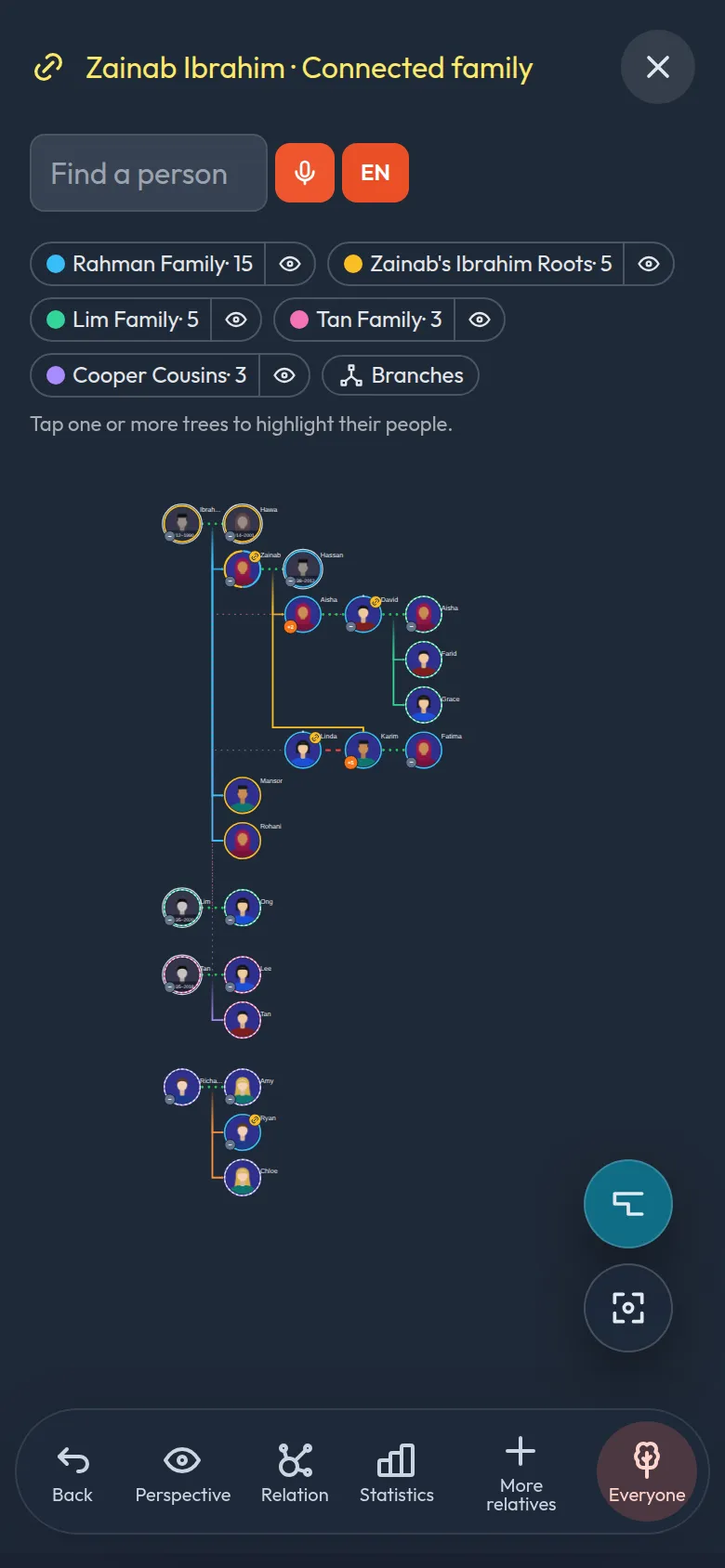
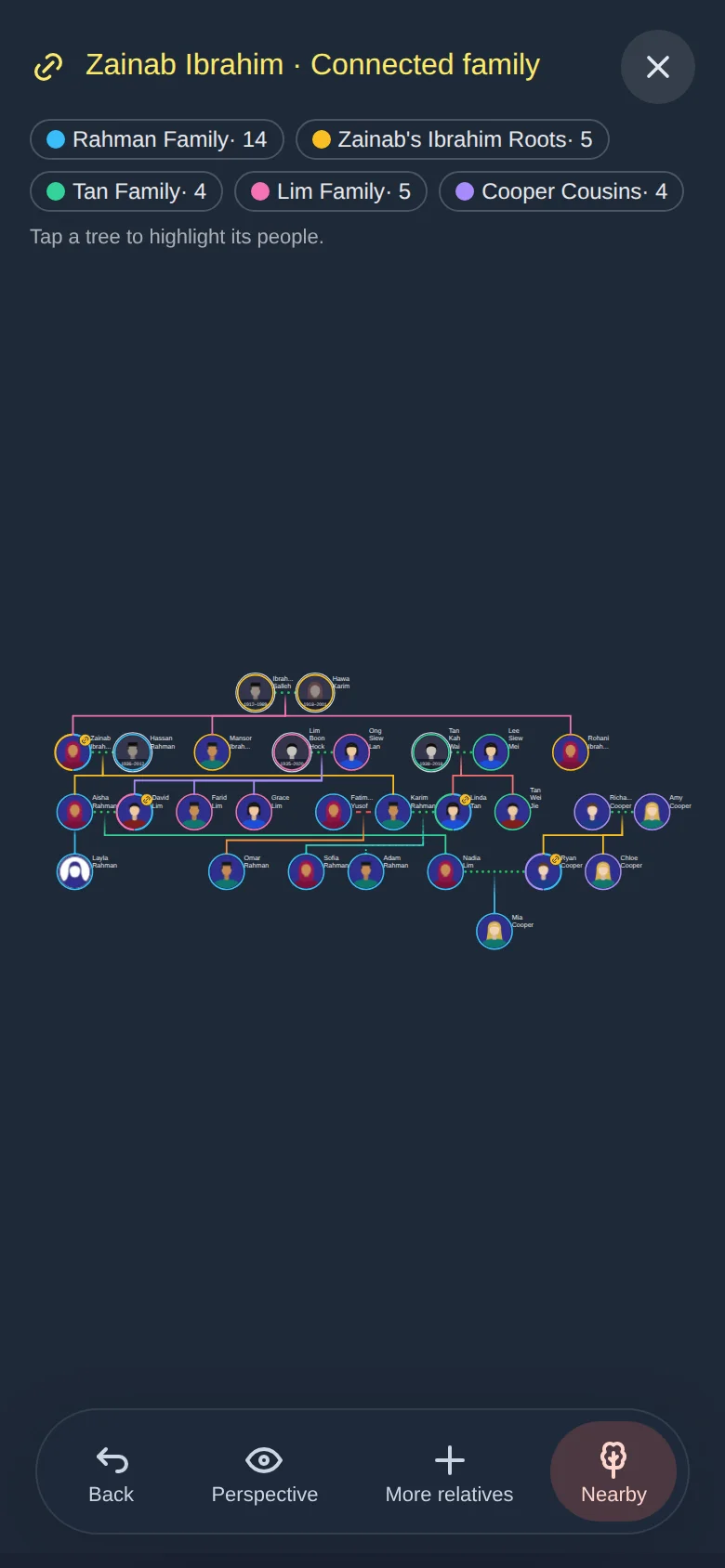
Tap Forests in the bottom bar. Every group of trees that are joined together, and that you can open, is one card: the trees in it (each in its own colour), the number of people, and when it last changed.
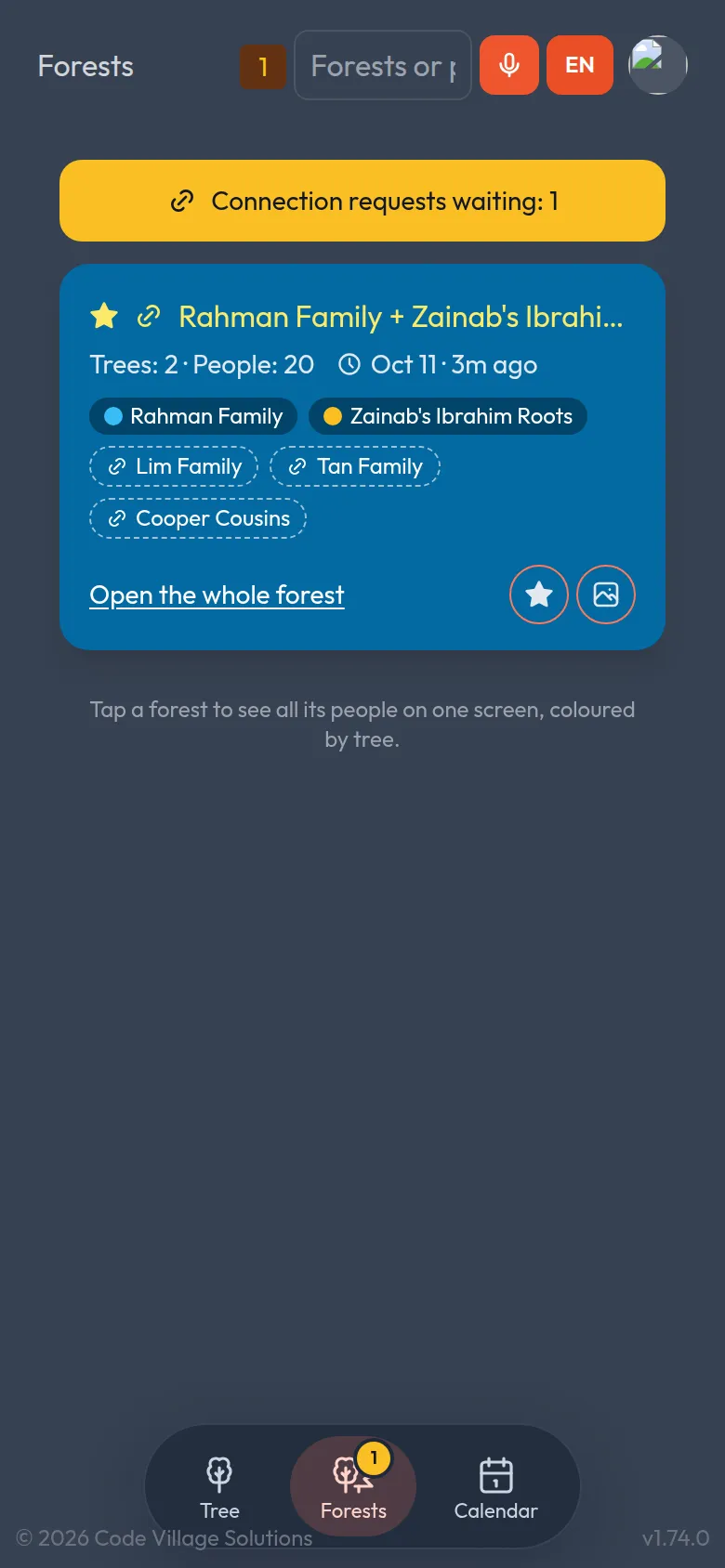
Tap a card to open the whole forest on one screen. At the bottom right of each card are two round buttons: the star pins the forest to the top of the list (tap it again to unpin), and the picture button opens the forest's shared memories.
Chips with a dashed outline are trees of other families that the forest shows you although you cannot open them; you see only what they share. They are the same trees you see when you open the forest.
A pin is yours alone and follows the forest: if a tree joins or leaves it, it stays pinned.
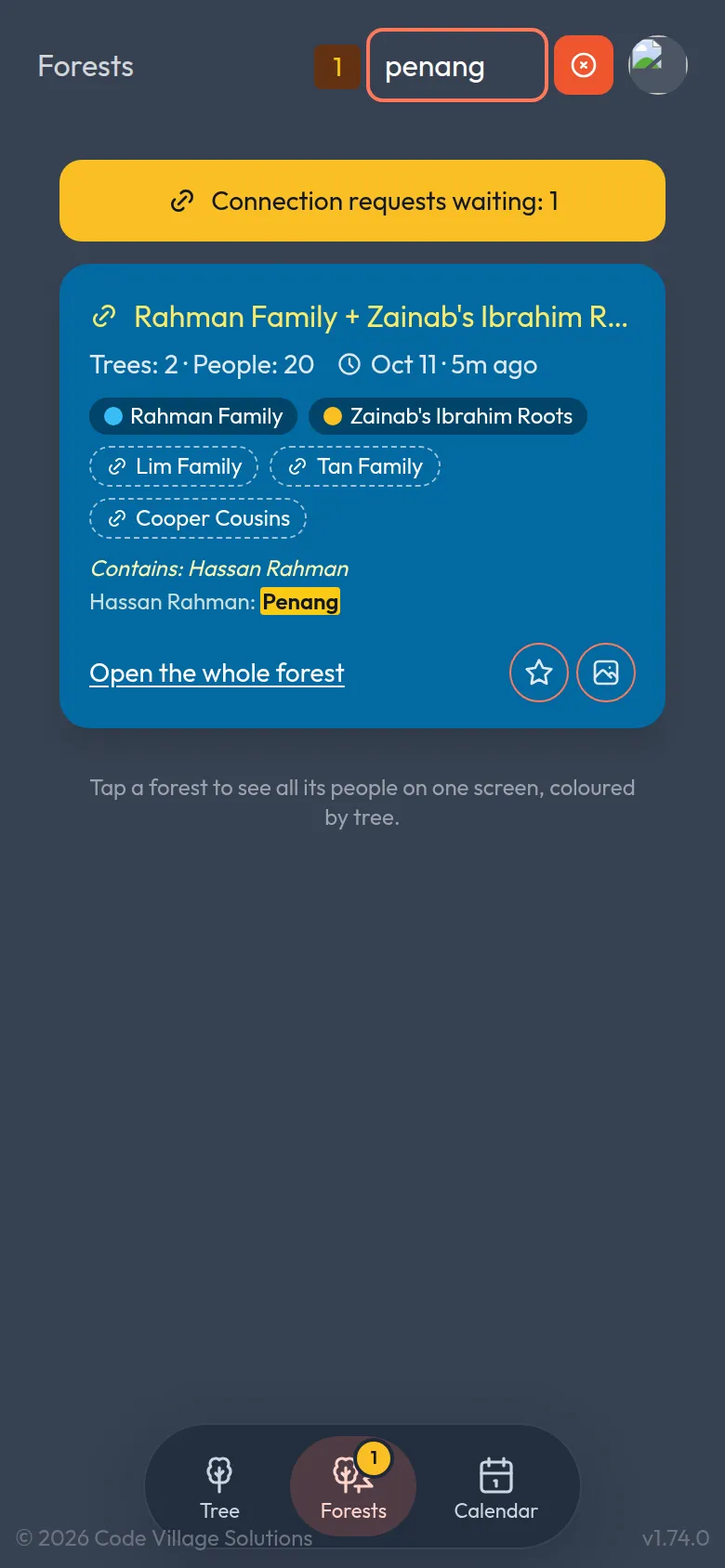
The Forests page uses the same search box as the trees page, at the top of the screen (the yellow number beside it counts your forests). It finds a forest by the name of one of its trees, or by a person in them, by name or by any detail you may see, and shows who matched under the forest.
Reading a forest
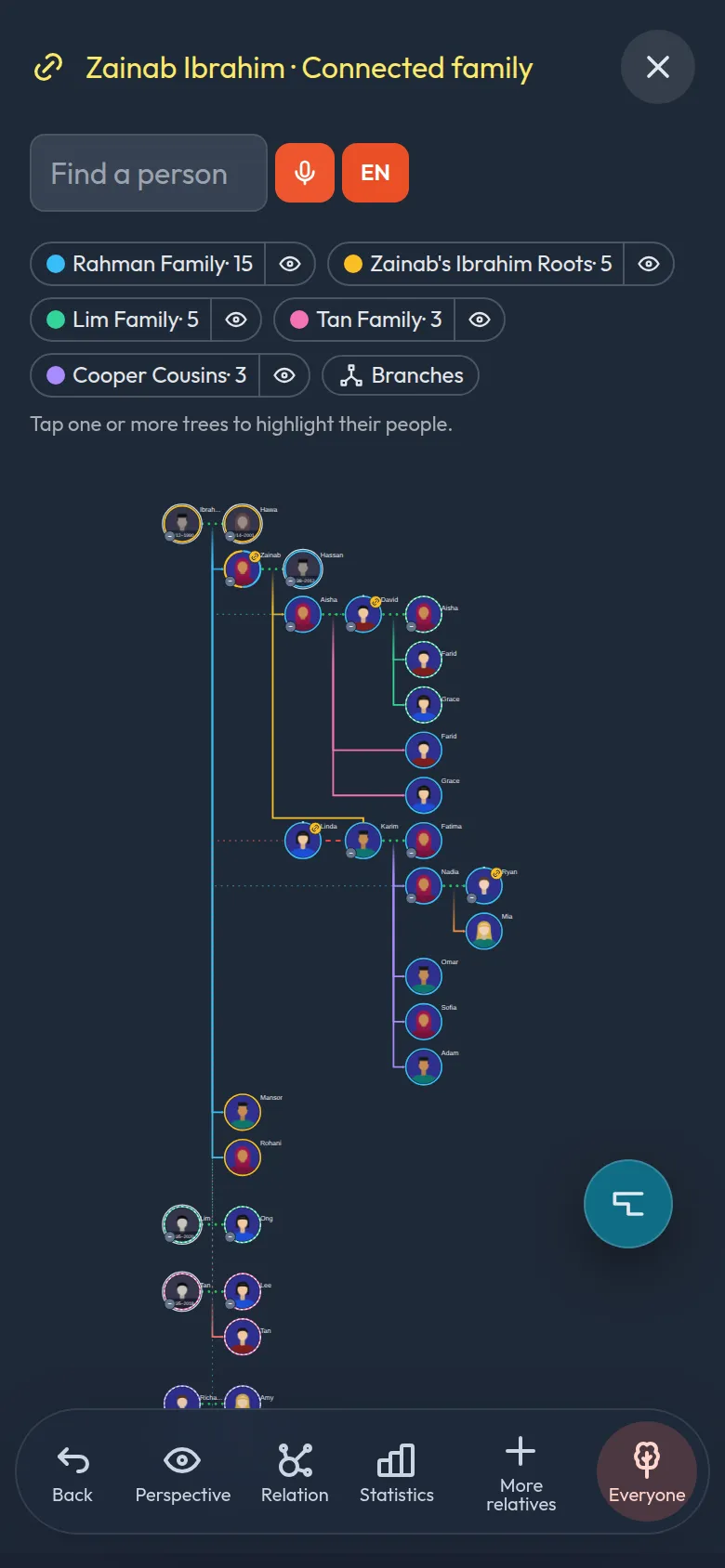
- Each person has a ring in their tree's colour. A person who is in several trees has a ring split into coloured arcs.
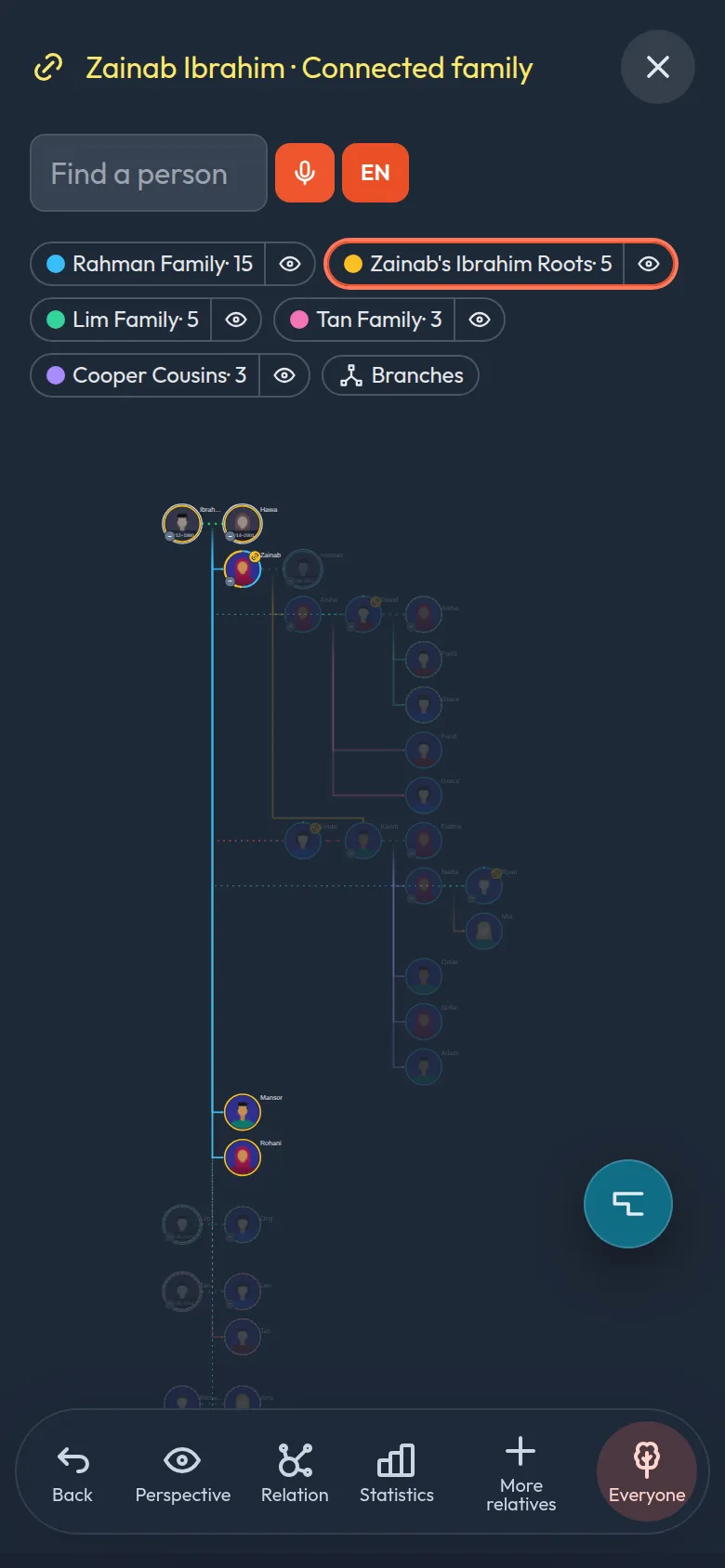
- The coloured chips at the top are the legend. Each chip shows the tree and how many people it has. Tap a chip to light up that tree's people. Tap more chips to light up several trees together; tap a lit chip again to take it off.
- The search box at the top finds a person among the people shown (name, nickname, year, or anything else you may see about them, such as contact, residence or hobbies); tap a result to centre on them. Switch to Everyone first to search the whole forest.
- Dashed rings mark people from a tree you cannot open. You see the people near the connection (or their whole tree, if that family ticked My whole tree), and only what they chose to share.
- The bottom bar has Back (return to the Forests page), Perspective, More relatives (reveal more people) and Nearby / Everyone (the button names what you are looking at now: Nearby is the circle of relatives around the centre person, Everyone, highlighted, is the whole connected family as far as each family shares it; tap to switch). More relatives adds 4 steps to the circle, up to about 120 people.
When a forest gets big
A forest with many people becomes hard to read on a phone. Three things help, and Asal Ku remembers them for you, forest by forest. Nobody else sees what you fold or hide.
- Fold a branch. Under a person who has children there is a small grey −. Tap it and everyone below that person folds away; the badge turns into an orange + with the number hidden. Tap it again to open the branch. You can also press and hold a person and choose Fold this branch.
- Hide a tree. Each chip has an eye. Tap it to hide that whole tree (its people and lines go); tap it again to bring it back. At least one tree always stays shown.
- Branches. The Branches button beside the chips opens a menu: Unfold everything, Show 2, 3 or 4 generations, and Back to the usual view, which forgets your folds and hidden trees.
- Big forests start shorter. The first time you open a forest of more than 60 people, only the first three generations show, and a note tells you so. Tap an orange + to open a branch.
- Names fade as you zoom out. Far out, only each person's first name shows, and further out none, because they could not be read anyway. Zoom in to read them.
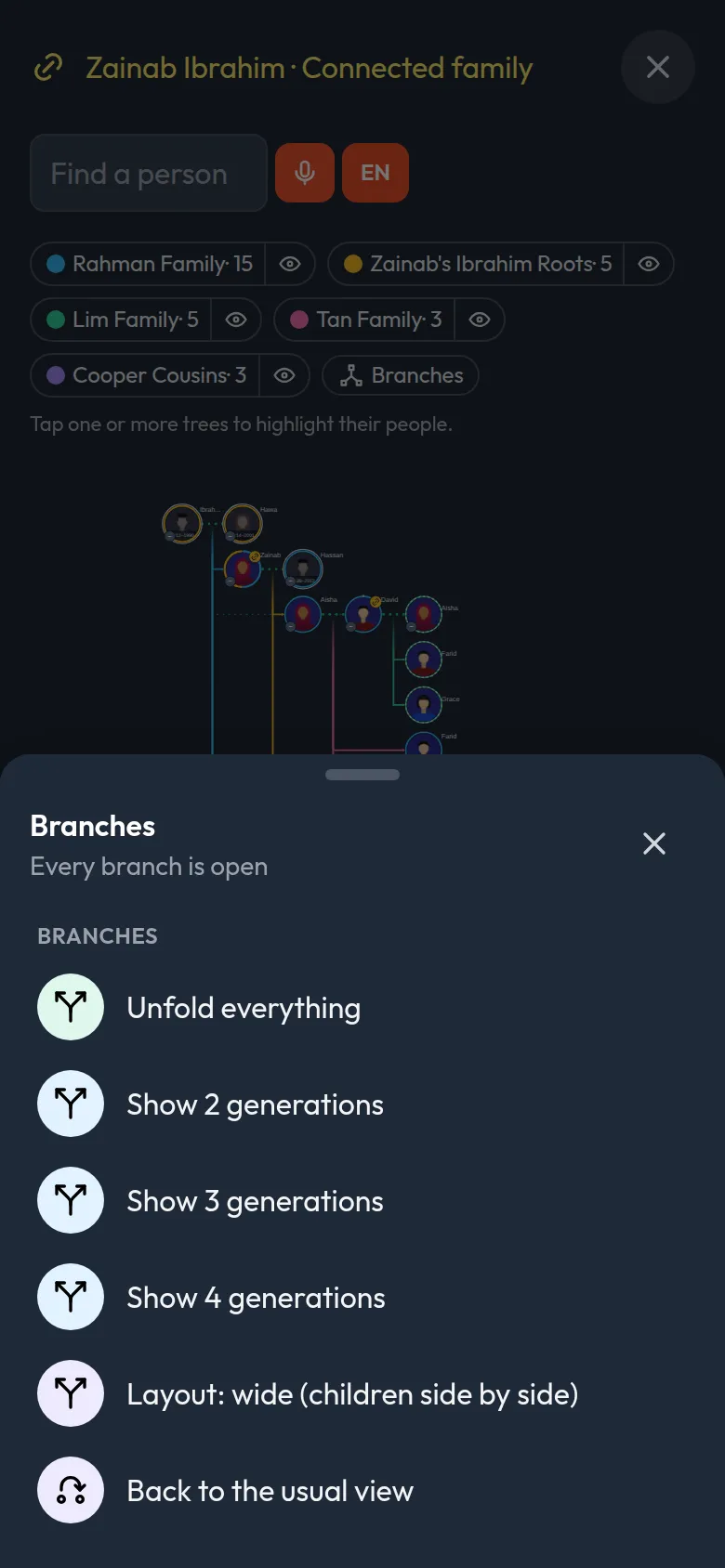
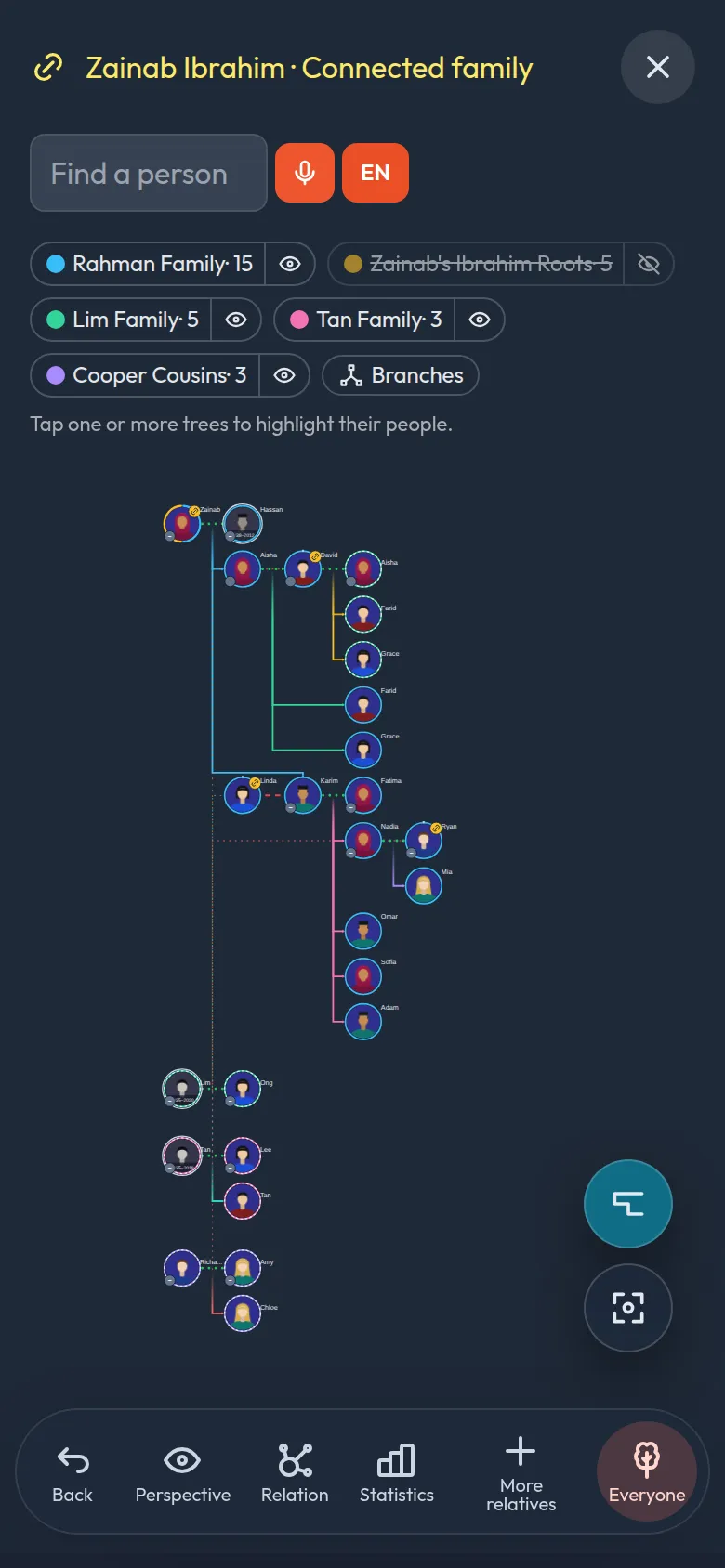
Click a person, then press − to fold their branch, + to open it, or * to open every branch.
You cannot edit in a forest view. To change a person, open their own tree.
Seeing and changing a person's connections
Tap the little gold chain on a person (or press and hold a person, then Connections). A list shows each tree the person is also in, what each shows, and:
- the tick boxes for what the other tree shows of this person, and what you show;
- when the two trees disagree about the person's parents, a choice of which parents this tree shows;
- a button to Open in the other tree (when you are allowed to), and Disconnect;
- See the connected family at the top, which opens the forest.
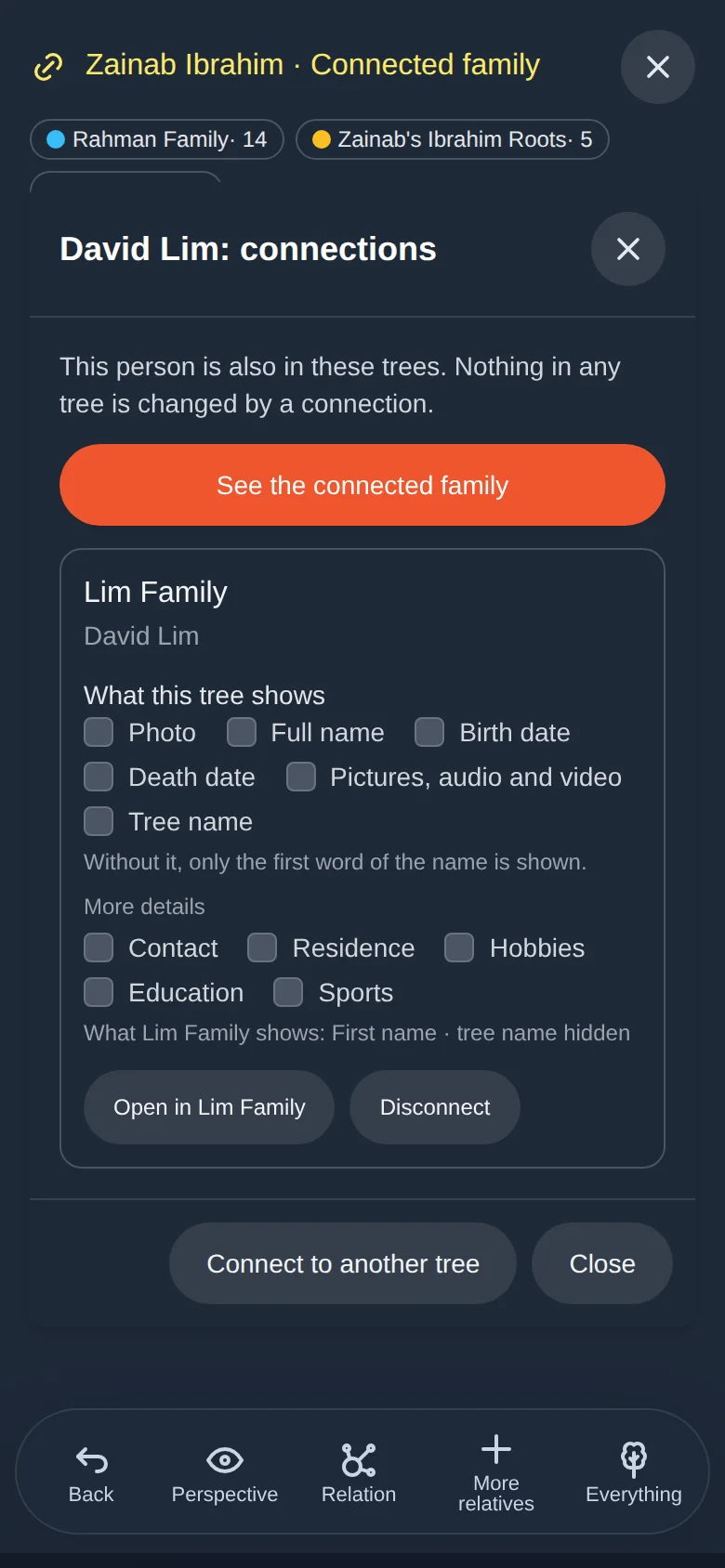
Disconnecting deletes nobody. It only stops the two trees being shown together.
Removing a connection
You can take a connection away whenever you like.
Open the tree and find the linked person (they have the little gold chain). Press and hold them, or click them on a computer, and choose Connections.
The list shows each tree the person is connected to. Tap Disconnect beside the one you want to remove.
Confirm "Disconnect … from …? Nothing in either tree is deleted."
- Nothing is deleted. Both trees keep all their people and photos. They simply stop being shown together.
- Who can do it. An owner or manager of either tree, or the person who made the connection. Viewers cannot.
- The other family is told. People who can open either tree see a short message and their view refreshes.
- Reconnecting. Connecting again needs a new request, and the other tree's owner has to approve it again.
- A request nobody has answered. Open the Forests tab, find the request in the list of connection requests and tap Withdraw (or Remove for one that was declined).
- Only hide something? You do not have to disconnect. In the same list, untick what you show to that tree (photo, names, dates, gallery) and the connection stays.
Who can find my trees?
By default, nobody can find your trees by searching. If you want relatives to ask to connect, switch on Let relatives find this tree by name tree by tree, in the gear at the top of the tree. A person who searches then sees only a name, a birth year and, if you ticked it, the tree name. Nothing is connected unless you accept their request.
Live updates
You do not need to refresh. When someone asks to connect, answers your request, or changes a tree connected to yours, a notice appears at the bottom and the forest on your screen updates.
Private things stay private: the notice names a tree only if you can open that tree.
Try it yourself
- If you have two trees that share a person, connect them. Tick only Photo and leave Full name unticked, so only the first word of the name is shown.
- Open the Forests page and open the forest. Tap legend chips to light up one tree, or several.
- Open the person's Connections and untick Photo.
Remember
- A connection joins what you see. Nothing is merged and nobody can edit the other tree.
- Another family's tree needs their approval.
- By default only a first name is shown, and your tree's name is hidden.
- You can disconnect at any time.