 Asal Ku Training
Start here › Lesson 13
How are two people related?
Tap any two people and Asal Ku names their relationship in the words your family's language uses, and shows the steps between them.
In this lesson you will learn
- How to pick two people and ask how they are related
- How to read the answer, the steps and the notes
- Why the same relationship has different names in different languages, and how to see the words of another language
- What the app needs to know about people to answer well
Why this is useful
"Is she my aunt or my cousin?" "What do I call my wife's elder brother?" Families are full of relationships that are hard to name, and every language and culture names them differently. Pick two people in a tree and Asal Ku works it out from the tree and tells you, in your language.
Ask about two people
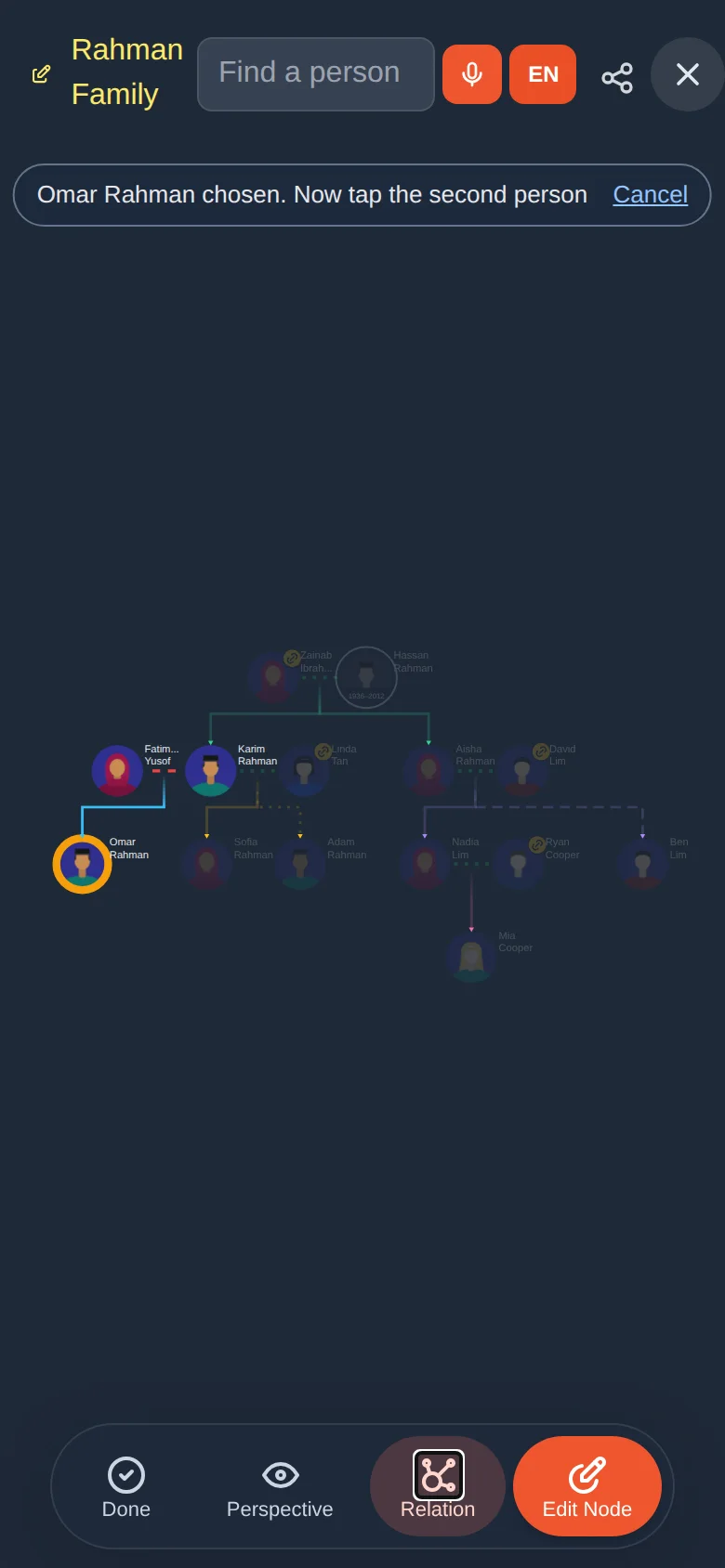
Open a tree (lesson 4). In the bottom bar, tap Relation. A message says "Tap one person, then another, to see how they are related".
Tap the first person. They get an amber ring, and the bar at the top says who you chose.
Tap the second person. A window opens with the answer. (Tapped the wrong first person? Tap them again to take the choice back, or tap Cancel.)
On a phone you can also press and hold a person and choose How are we related to…?. That person becomes the first one; then tap the second. The same works in a connected family (lesson 10), where the two people may be in different trees.
Reading the answer
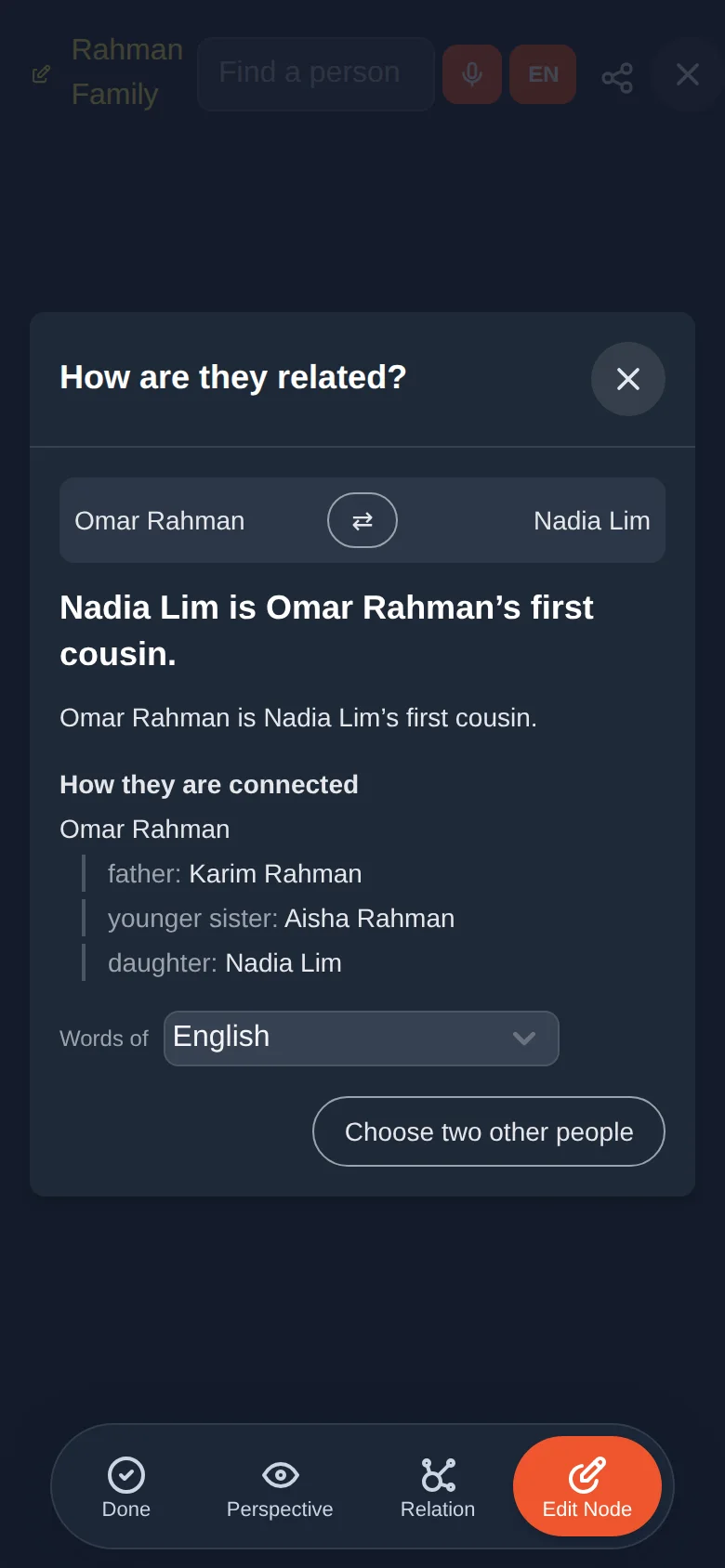
- The big sentence says what the second person is to the first: "Nadia Lim is Omar Rahman's first cousin."
- The line below it says it the other way round: "Omar Rahman is Nadia Lim's first cousin." Often the two names are different (aunt and nephew, grandfather and grandson), and the app gives you both.
- How they are connected lists the people between them, one step at a time: Omar's father Karim, Karim's younger sister Aisha, Aisha's daughter Nadia. If a relationship has no single word in the language you chose, this list is how the app explains it, and the sentence spells it out too ("wife's mother's older brother").
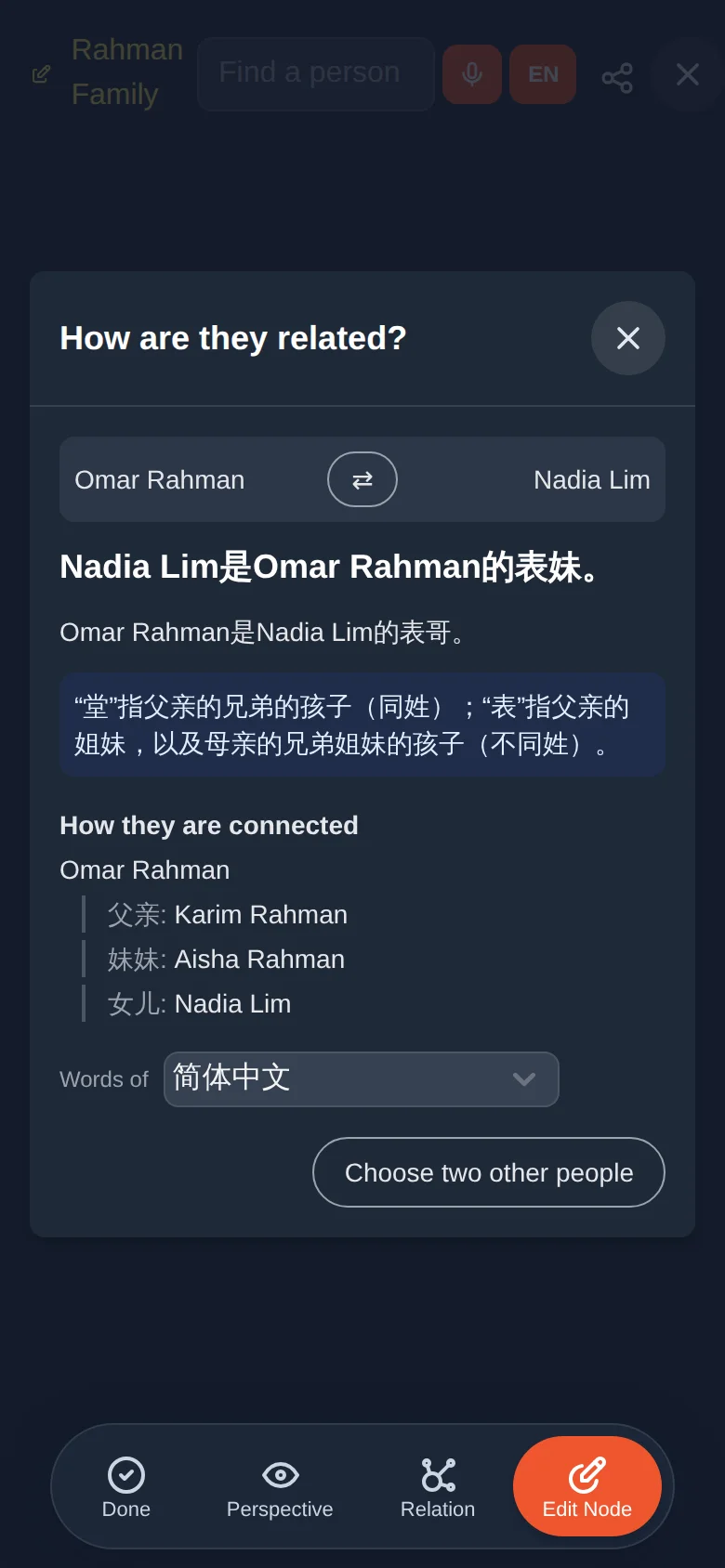
- A blue box explains, in that language, how its culture names this kind of relative, when there is something worth knowing.
- An amber box appears when two people are married and related by blood (for example married cousins).
- Tap ⇄ to swap the two people. Tap Choose two other people to start again.
The words of another culture
The answer uses the language you chose in Settings. At the bottom of the window, Words of lets you read the same answer in any of the eight languages without changing the app. This is handy in a family where grandparents say it one way and the grandchildren another.
Why the names change with the language
English has one word, "cousin", for a dozen kinds of relative. Many languages have a separate word for each, depending on which side of the family (father's or mother's), whether the person is older or younger, and whether the link is through a brother or a sister. A few examples:
| This relative | English | Bahasa Melayu | 中文 | தமிழ் | ไทย | Filipino |
|---|---|---|---|---|---|---|
| Father's older brother | uncle | bapa saudara (Pak Long, if the eldest) | 伯父 | பெரியப்பா | ลุง | tiyo |
| Father's younger brother | uncle | bapa saudara | 叔叔 | சித்தப்பா | อา | tiyo |
| Father's sister | aunt | emak saudara | 姑姑 | அத்தை | ป้า or อา | tiya |
| Mother's brother | uncle | bapa saudara | 舅舅 | மாமா | ลุง or น้า | tiyo |
| Mother's younger sister | aunt | emak saudara | 姨妈 | சித்தி | น้า | tiya |
| Father's mother | grandmother | nenek | 奶奶 | பாட்டி | ย่า | lola |
| Mother's mother | grandmother | nenek | 外婆 | பாட்டி | ยาย | lola |
| Father's brother's older son | cousin | sepupu | 堂哥 | ஒன்றுவிட்ட அண்ணன் | ลูกพี่ลูกน้อง | pinsang buo |
| Father's sister's son | cousin | sepupu | 表哥 / 表弟 | அத்தை மகன் (cross cousin) | ลูกพี่ลูกน้อง | pinsang buo |
| Wife's older brother | brother-in-law | abang ipar | 大舅子 | மச்சான் | พี่ชายของภรรยา | bayaw |
A few things worth knowing, by language
- English counts cousins by degree and "removed": a second cousin shares great-grandparents; a first cousin once removed is one generation apart.
- Bahasa Melayu names brothers and sisters of your parents by their birth order: Long (eldest), Ngah (second), Alang (in the middle) and Su (youngest). If everyone's birth date is in the tree, Asal Ku shows this as "Mak Long" or "Pak Su". Cousins are sepupu (first), dua pupu (second) and tiga pupu (third). In-laws are ipar, and besan is how the parents of a married couple are to each other.
- Bahasa Melayu Utara (Kedah, Perlis, Penang) says tok for a grandfather and wan for a grandmother, and abah and mak for parents.
- Bahasa Indonesia has kakak (older) and adik (younger), paman and bibi (om and tante in everyday speech; Javanese families say pakde and bude for the older ones). Cousins are counted sepupu satu kali, dua kali…, and great-grandparents go buyut, canggah, wareng.
- Filipino uses kuya and ate for an older brother and sister (and older cousins), tiyo and tiya for uncle and aunt, and counts cousins pinsang buo, pinsang makalawa… The parents of a married couple are balae.
- 中文 (Chinese) separates the father's side from the mother's: 爷爷 and 奶奶 are the father's parents, 外公 and 外婆 the mother's. The father's elder brother is 伯父 and his younger brother 叔叔; the mother's brother is 舅舅. Cousins are 堂 (children of the father's brothers, same surname) or 表 (all the others), and each is 哥, 弟, 姐 or 妹 by age.
- தமிழ் (Tamil) treats your father's brothers and mother's sisters like parents (periyappa, chithappa, periyamma, chithi), and their children like brothers and sisters. Children of your father's sister (athai) and mother's brother (mama) are cross cousins, called machan and machini. A man's sister's children, and a woman's brother's children, are marumagan and marumagal.
- ไทย (Thai) says ปู่ and ย่า for the father's parents and ตา and ยาย for the mother's. A parent's older brother or sister is ลุง or ป้า on either side; a younger sibling of the father is อา, of the mother น้า. Grandchildren, nieces and nephews are all หลาน.
Families and regions differ, and many families use nicknames or a mix of languages. Treat the answer as the standard word. If your family says it differently, that is normal.
What the app needs to know
- Which person is you. Press and hold your own name and choose This is me (lesson 14). Then the sheet writes "(you)" next to your name, and the press-and-hold menu of everyone else offers How am I related to them?.
- Gender. Without it the app uses neutral words ("sibling", "uncle or aunt").
- Birth dates. They tell who is older, which matters in Malay, Chinese, Tamil, Thai and Filipino. A year is enough. Without a date the answer says "older or younger sibling" or similar.
- The links. Parents, children and spouses as you entered them (lesson 5). Adopted, foster and step relationships, and divorced couples, change the words ("stepmother", "ex-husband").
- Only the people you can see. If the link between two people goes through someone you cannot see (in a connected family, for example), the app says it found no family connection.
Try it yourself
- Open your Practice Tree and tap Relation.
- Pick yourself and a cousin. Read the answer in both directions.
- Change Words of to another language and read it again.
- Pick two people who are married. Is there anything in the amber box?
Remember
- Tap Relation, then two people. The answer names the relationship both ways.
- The words follow the language you chose, and you can read them in any of the eight languages.
- Birth dates and genders make the answer more exact.